
1 (800) 864-8714
1 (800) 864-8714
1 (800) 864-8714
1 (800) 864-8714
RESEARCH
Reduction in PCBs
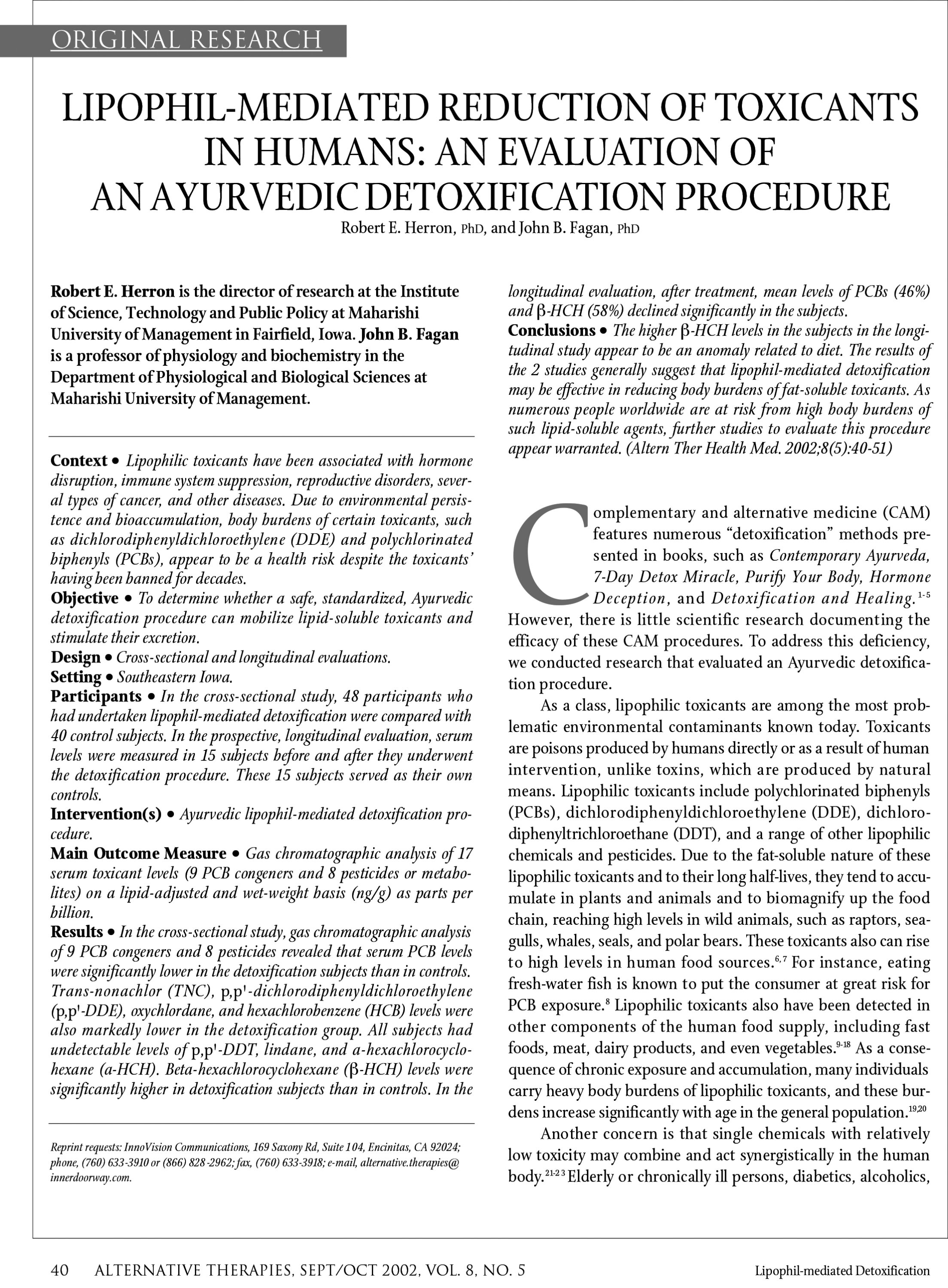

A published scientific study conducted at The Raj Ayurveda Health Center in Maharishi Vedic City, Iowa, found that a five-day Ayurvedic purification program was associated with substantial reductions in certain persistent, fat-soluble environmental toxicants in the blood.
The two-month longitudinal study reported a 46% reduction in polychlorinated biphenyls, or PCBs, and a 58% reduction in beta-HCH, an organochlorine pesticide-related compound, following the Panchakarma program.
The research was conducted by Robert E. Herron, PhD, and John B. Fagan, PhD, and published in the September–October 2002 issue of Alternative Therapies in Health and Medicine.
These findings suggest that the comprehensive Panchakarma program offered at The Raj may help reduce the body burden of certain persistent fat-soluble toxicants.
Fat-soluble, or lipophilic, toxicants can accumulate in the body’s fatty tissues and remain there for extended periods.
Certain chemicals in this category persist in the environment and may continue to enter the food chain even decades after their use has been restricted or banned.
Examples examined in the research included:
Because these substances can accumulate in plants and animals, their concentrations may increase as they move through the food chain. Human exposure can therefore continue through food and the broader environment.
Persistent environmental toxicants have been studied for their potential relationships with hormone disruption, immune function, reproductive health, and other health concerns.
The presence of a chemical in the body does not by itself establish that it has caused a particular illness.
The study, titled “Lipophil-Mediated Reduction of Toxicants in Humans: An Evaluation of an Ayurvedic Detoxification Procedure,” was authored by Robert E. Herron, PhD, and John B. Fagan, PhD.
It was published in the September–October 2002 issue of Alternative Therapies in Health and Medicine.
The researchers conducted two related investigations:
The Panchakarma treatments evaluated in the study were conducted at The Raj Ayurveda Health Center.
In the longitudinal portion of the research, the investigators reported statistically significant reductions in the mean blood levels of certain toxicants following treatment:
Together, these results are often summarized as an approximately 50% reduction in certain fat-soluble toxicants.
The study also examined DDE and additional persistent compounds. However, the published abstract specifically identifies the 46% and 58% reductions as applying to PCBs and beta-HCH.
The researchers concluded that the findings generally suggested that the procedure may be effective in reducing the body burden of certain fat-soluble toxicants. They also stated that further research was warranted.
The participants completed a five-day Ayurvedic purification program at The Raj, where the treatments were administered as a coordinated, individualized Panchakarma program.
The program incorporated principles and treatments associated with Maharishi Ayurveda and Panchakarma.
Panchakarma is a traditional, individualized Ayurvedic purification and rejuvenation program that may include specialized oil treatments, heat therapies, dietary measures, rest, and other procedures selected according to the individual.
The published research evaluated the complete procedure as a combined program. It did not establish that any single treatment was independently responsible for the reported changes.
Persistent fat-soluble toxicants are difficult to study because they may remain stored in the body for years and decline very slowly without intervention.
The substantial changes observed during the relatively short study period were therefore considered noteworthy.
The findings provide preliminary scientific evidence that a comprehensive Ayurvedic purification program may support the reduction of certain persistent toxicants.
However, this was a relatively small study, and the results should not be interpreted as proof that Panchakarma removes every type of environmental toxin or treats diseases associated with toxicant exposure.
Larger, independently replicated studies are needed.
Herron RE, Fagan JB. Lipophil-mediated reduction of toxicants in humans: an evaluation of an Ayurvedic detoxification procedure. Alternative Therapies in Health and Medicine. 2002;8(5):40–51. PMID: 12233802.
Read the full published study PDF
View the study record and abstract on PubMed
The Raj offers authentic, personalized Panchakarma programs in a peaceful residential setting designed specifically for Ayurveda.
Each guest’s program is selected according to their individual needs and may include Ayurvedic Wellness expert consultations, customized treatments, specialized herbalized oils, Ayurvedic meals, and time for deep rest.
This information is presented for educational purposes and is not intended to diagnose, treat, cure, or prevent any disease. Individual results vary. Panchakarma may not be appropriate for everyone and should be undertaken with qualified professional guidance.

Research on comprehensive Ayurvedic rejuvenation programs has reported reductions in certain fat-soluble toxicants, improvements in cardiovascular and stress-related markers, and measurable changes in brain activity during Shirodhara.

An 11-year analysis of Blue Cross/Blue Shield data found 63% lower medical expenditures, 80% fewer hospital admissions, and 55% fewer outpatient visits among Maharishi Ayurveda participants compared with normative data and controls.

The American Heart Association states that Transcendental Meditation may be considered for lowering blood pressure. A randomized controlled study also found significant reductions in systolic and diastolic blood pressure with TM.