
1 (800) 864-8714
1 (800) 864-8714
1 (800) 864-8714
1 (800) 864-8714
RESEARCH
Patients Studied
A published case series evaluated four patients with different long-standing chronic disorders who participated in a comprehensive, personalized Ayurvedic program.
The patients had sarcoidosis, Parkinson’s disease, renal hypertension, and a combination of type 2 diabetes, essential hypertension, and anxiety disorder.
The researchers evaluated symptoms and objective clinical measurements before, during, and after the program. They reported improvements in major signs and symptoms, clinical measurements, quality of life, and the use of conventional medications.
The researchers formally described the approach as Maharishi Vedic Medicine, an integrated, multimodality form of Ayurveda combining personalized treatments, dietary guidance, herbal preparations, purification procedures, meditation, daily routines, and continued home recommendations.
Because the research included only four patients and did not have a control group, the findings should be considered preliminary.
Chronic disorders often involve several interconnected aspects of health rather than one isolated symptom.
Physical functioning, digestion, stress, sleep, diet, daily habits, medication use, and emotional well-being may all influence a person’s experience of a long-term condition.
Ayurveda takes a whole-person approach. Instead of giving every patient the same treatment, the program studied was individualized according to each person’s health history, symptoms, clinical evaluation, and traditional Ayurvedic assessment.
This allowed several areas of health to be addressed together. However, because the patients received multiple therapies at the same time, the study could not determine which individual component contributed to the reported results.
The study, titled “Improvements in Chronic Diseases With a Comprehensive Natural Medicine Approach: A Review and Case Series,” was authored by Tony Nader, MD, PhD; Stuart Rothenberg, MD; Richard Averbach, MD; Barry Charles, MD; Jeremy Z. Fields, PhD; and Robert H. Schneider, MD.
It was published in Behavioral Medicine in 2000.
The case series followed four patients before, during, and after participation in an intensive residential Ayurvedic program.
The researchers evaluated:
The study evaluated the complete Ayurvedic approach rather than one individual treatment, herb, or procedure.
The first patient was a woman with Stage II multisystem sarcoidosis.
Before entering the program, she experienced severe fatigue, shortness of breath during physical activity, muscle and joint pain, recurring eye inflammation, skin lesions, and nodules around her elbows and eyelids.
Following the residential Ayurvedic program, the authors reported improvements in her breathing, energy, fatigue, muscle pain, and joint pain. They also reported changes in inflammatory measurements and reductions in several visible signs of the condition.
Follow-up evaluations indicated that a number of the reported improvements continued after the residential program.
This was the outcome of one patient and does not establish that the same results would occur in other people with sarcoidosis.
The second patient was a man with a 12-year history of type 2 diabetes and approximately 20-year histories of hypertension and anxiety.
He completed a 21-day residential Ayurvedic program.
During the program, the researchers reported reductions in his blood pressure and blood sugar measurements. His prescribed blood-pressure and anxiety medications were gradually discontinued under medical supervision, while his diabetes medication was reduced.
At follow-up, his hemoglobin A1C had decreased from 8.4 to 7.4. His blood pressure and mood were also reported to have remained stable without blood-pressure or anxiety medication at the three-month follow-up.
Medication changes described in this case occurred as part of a supervised clinical program. No one should reduce or discontinue prescribed medication without guidance from a qualified healthcare professional.
The third patient was a woman with a 30-year history of hypertension associated with kidney damage following an earlier urinary obstruction.
Before the program, her average home blood pressure was reported as 146/97 mm Hg. Her creatinine clearance, a measurement used to help assess kidney filtration, was also below the study’s stated normal range.
Following the program, her creatinine clearance increased from 67 to 85 mL per minute.
During the two months after the residential program, her average blood pressure was reported as 129/85 mm Hg without medication. One year later, her average home blood pressure remained within the normal range at approximately 130/84 mm Hg.
This individual case does not demonstrate that an Ayurvedic program can replace standard medical care for hypertension or kidney disease.
The fourth patient was a woman who had been diagnosed with Parkinson’s disease eight years earlier.
Despite conventional medication, she had experienced progressively worsening symptoms, including increasing periods of freezing and immobility.
She initially completed a 21-day residential Ayurvedic program and later returned for two additional programs.
The researchers reported improvements in walking, postural stability, speech, handwriting, involuntary movements, tremor, and daily functioning. They also reported that her freezing episodes stopped following the later programs.
Her neurological evaluation scores improved, and her daily dosage of Parkinson’s medication was reduced under medical supervision. The authors reported that the improvements continued at a follow-up three months after her third residential program.
This was one patient’s experience and should not be interpreted as evidence that Ayurveda cures Parkinson’s disease.
The study evaluated a comprehensive Ayurvedic program rather than one isolated therapy.
The program was personalized for each patient and included several components, which could include:
The residential treatments were selected according to each patient’s health needs and clinical indications.
Because the therapies were delivered as one coordinated program, the research did not establish that any single component was independently responsible for the reported changes.
The four patients had very different chronic disorders involving the immune, neurological, cardiovascular, metabolic, renal, and psychological systems.
The reported improvements suggest that a personalized, comprehensive Ayurvedic approach may be worthy of further scientific investigation for people with complex or long-standing health concerns.
The study also examined more than symptom relief. Depending on the individual case, the researchers considered blood pressure, blood sugar, kidney filtration, inflammatory findings, neurological scores, quality of life, and conventional medication use.
However, case reports are primarily useful for documenting observations that can later be investigated in larger and more rigorous studies. They cannot predict whether the same outcomes will occur in other patients.
This was a case series involving only four patients. It was not a randomized or controlled clinical trial.
There was no comparison group receiving usual medical care, a placebo, or another intervention.
The patients received several Ayurvedic treatments and lifestyle recommendations simultaneously. It is therefore not possible to determine which components may have contributed to the reported changes.
Some findings were based on patient-reported symptoms, although the researchers also used laboratory testing, blood-pressure measurements, imaging, neurological evaluations, and other clinical assessments.
Medication reductions occurred under supervision within the patients’ treatment programs. The findings should not be interpreted as evidence that people can safely reduce or discontinue prescribed medication on their own.
Larger, independently conducted controlled studies are needed before conclusions can be drawn about the effectiveness of the program for any particular disorder.
Nader T, Rothenberg S, Averbach R, Charles B, Fields JZ, Schneider RH. Improvements in chronic diseases with a comprehensive natural medicine approach: a review and case series. Behavioral Medicine. 2000;26(1):34–46. DOI: 10.1080/08964280009595751. PMID: 10971882.
Read the complete published study
View the study record and abstract on PubMed
View the article through its DOI
The Raj offers authentic, personalized Ayurvedic programs for guests with chronic and complex health concerns.
Rather than providing the same treatment to every guest, each program is selected according to the individual’s health history, current needs, and Ayurvedic assessment.
A residential program may include consultations with Ayurvedic wellness experts, personalized Panchakarma treatments, specialized herbalized oils, Ayurvedic meals, lifestyle recommendations, stress-reduction practices, and time for deep rest.
The program offered to each guest may differ from the program evaluated in this case series. Individual experiences and results vary.
This information is provided for educational purposes and is not intended to diagnose, treat, cure, or prevent any disease. A four-patient case series cannot predict an individual’s results. Ayurveda should complement, not replace, appropriate medical care. Do not begin, delay, change, or discontinue medical treatment or prescribed medication without consulting a qualified healthcare professional.

An 11-year analysis of Blue Cross/Blue Shield data found 63% lower medical expenditures, 80% fewer hospital admissions, and 55% fewer outpatient visits among Maharishi Ayurveda participants compared with normative data and controls.

Research on comprehensive Ayurvedic rejuvenation programs has reported reductions in certain fat-soluble toxicants, improvements in cardiovascular and stress-related markers, and measurable changes in brain activity during Shirodhara.
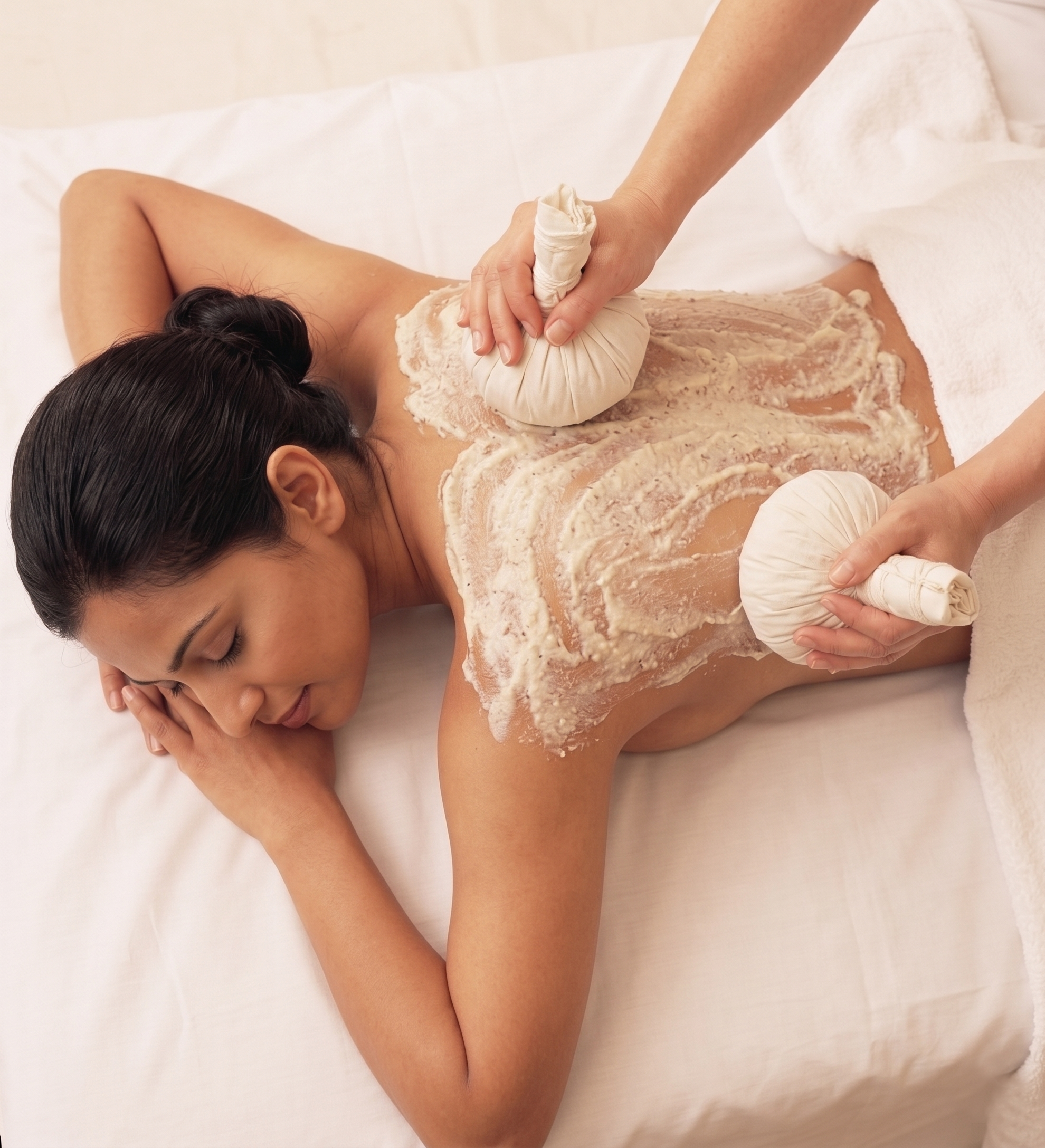
A published study conducted at The Raj found that a five-day Panchakarma program was associated with a 46% reduction in PCBs and a 58% reduction in beta-HCH, two persistent fat-soluble environmental toxicants.